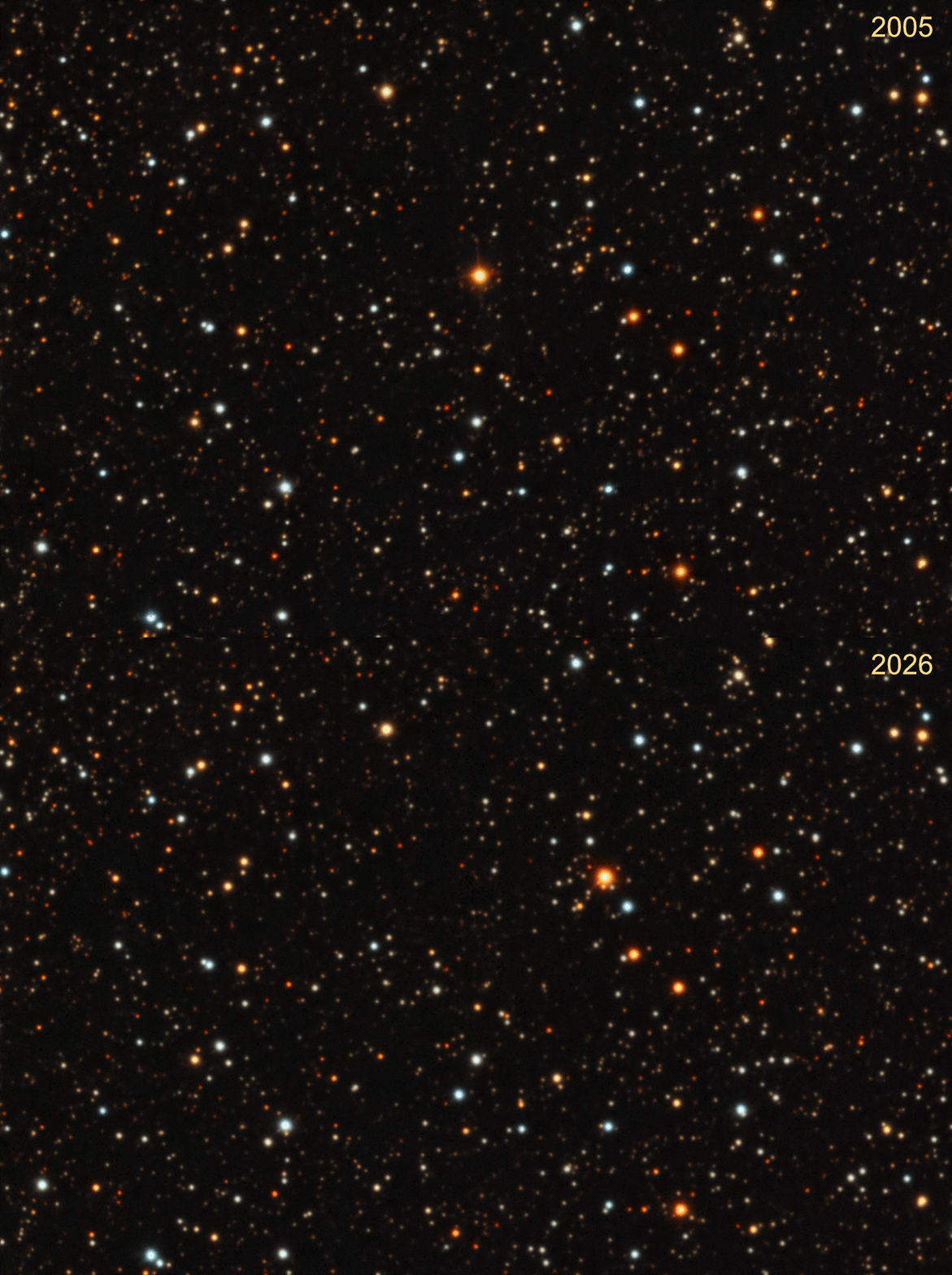
[back] Proxima Centauri (21 years animation)
Big
uncroped version / Große unbeschnittene Version (9037 x 6019 pixel, 0.743 ”/px )
(c) 2005-2026 All astro photo images are copyrighted. They may not be used or reproduced without explicit written permission from the authors.
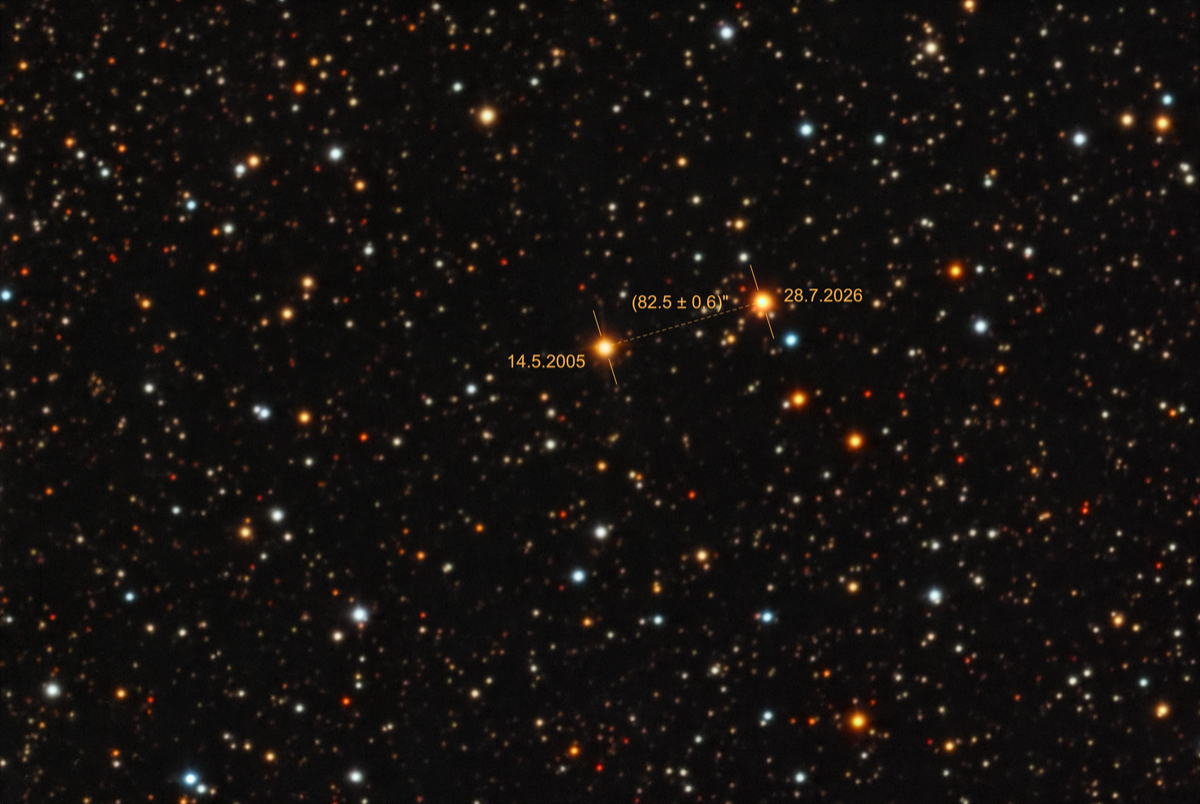
Marked position and distance / Positions-Markierungen und Abstand
(c) 2005-2026 All astro photo images are copyrighted. They may not be used or reproduced without explicit written permission from the authors.
About this Images / Über dieses Bilder
| Camera: | SBig ST10 XME (2005) and Moravian C3-PRO-61000 Mono CMOS (2026) |
| Image Type, Orientation: | RGB composite, North is at 12:00 |
| Exposure time/dates: | May 14th 2005 (19:00 UTC) and July 28th 2026 (19:00 UTC) 2005: RGB: 4/4/4 x 60s (0:12h total) 2026: RGB: 40/40/40 x 30s (2:00 total) |
| Locations: | 2005: Capella Observatory at Amani Lodge, Kupferberg near Windhoek,
Namibia 2026: Capella Observatory South at Kiripotib Astro Farm, Namibia |
| Filter: | 2005: Astronomik Typ II RGB filters on Neumann FR03 External
Filter Wheel 2026: Astronomik Deep-Sky RGB Filter on Moravian EFW-3L-9-II External Filter Wheel |
| Instruments: | 2005: "Ganymed", the 60cm-Hypergraph in
primary focus, f=1800
mm on K140 by Michael Knopf 2026: "Rhea", a PlaneWave DeltaRho 350, 1050mm focal length, 350mm aperture, f/3 on 10Micron GM2000 HPS II Combi |
| Photographer: | Josef Pöpsel, Rainer Raupach, Stefan Binnewies, Frank Sackenheim |
|
Remarks: |
Proxima Centauri is the nearest star
to the Sun. As an M-type dwarf with an effective surface temperature of just
under 3,000 K, it appears distinctly reddish. Its intrinsic luminosity is
only about 0.16% that of the Sun, making it an 11th-magnitude star despite
its close proximity. Consequently, it was not discovered until 1915. It is
now well established that Proxima Centauri is gravitationally bound to the α
Centauri system, orbiting it with a period of approximately 591,000 years.
The orbit has a periastron distance of about 5,270 AU and an apastron
distance of about 12,900 AU. Since α Centauri A itself has a close, more
massive companion (α Centauri B), Proxima Centauri is also designated α
Centauri C. |
|
Bemerkungen: |
Proxima Centauri ist der der Sonne am nächsten gelegene
Fixstern. Als M-Zwerg mit einer Oberflächentemperatur von knapp 3000K
erscheint er auffallend rötlich. Seine absolute Leuchtkraft beträgt nur
0.16% der Leuchtkraft der Sonne, so dass er trotz der räumlichen Nähe nur
eine Stern 11. Größenklasse bildet, und deswegen auch erst 1915 entdeckt
wurde. Mittlerweile gilt als erwiesen, dass Proxima Centauri gravitativ an
α Centauri gebunden ist und diesen mit ein Umlaufzeit von etwa 591000 Jahren
umkreist, bei einer Periastron-/Apastron-Distanz von 5270 AE bzw. 12900 AE.
Da α Centauri A zudem einen engeren, massereicheren Begleiter B hat, wird
Proxima Centauri auch als α Centauri C geführt. |
Proper motion
and parallax of Proxima Centauri between the two exposures
/ Eigenbewegung und Parallaxe von Proxima Centauri zwischen den
beiden Aufnahmen
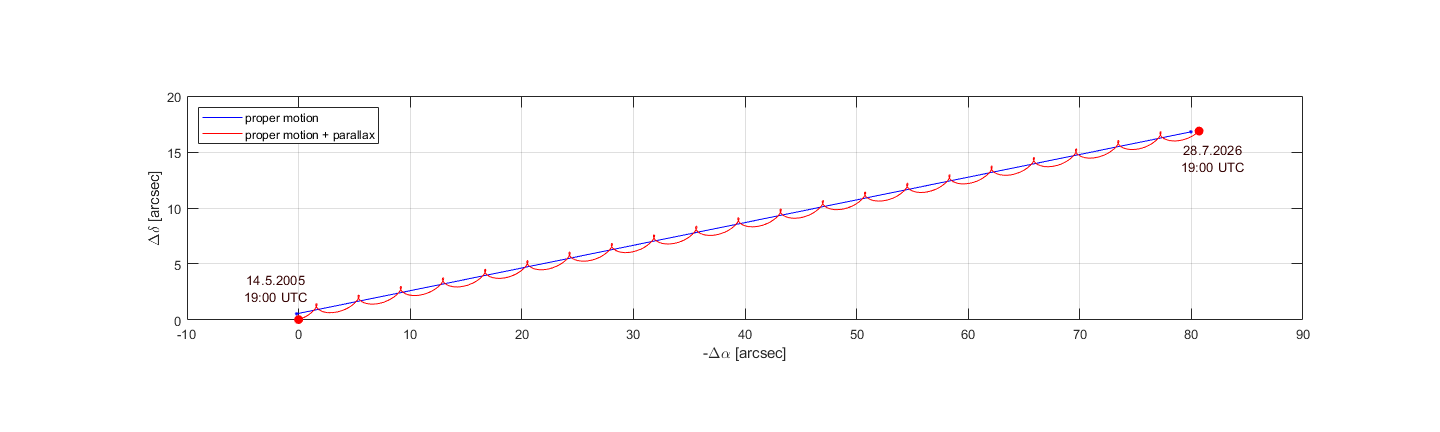
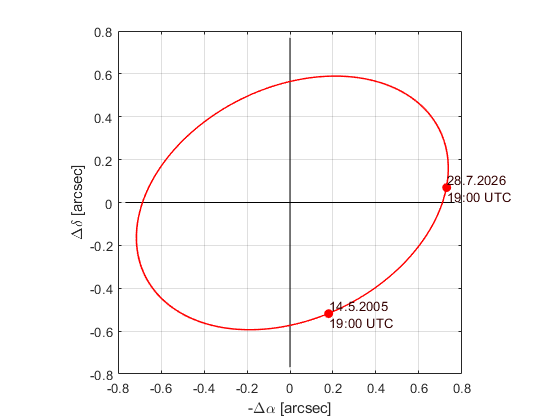
Parallax Motion
of Proxima Centauri / Parallaxen-Bewegung von Proxima
Centauri
Back to the "Star-Fields" Overview / Zurück zur "Sternfelder"-Übersichtsseite
 corresponding to a total angular displacement of (82.5 ± 0.6)“.
 accounts for the convergence of lines of right ascension in spherical
coordinates.
accounts for the convergence of lines of right ascension in spherical
coordinates.