Annotated Version / Beschriftete Version (9240 x 6323 pixel, 0.743 ”/px )
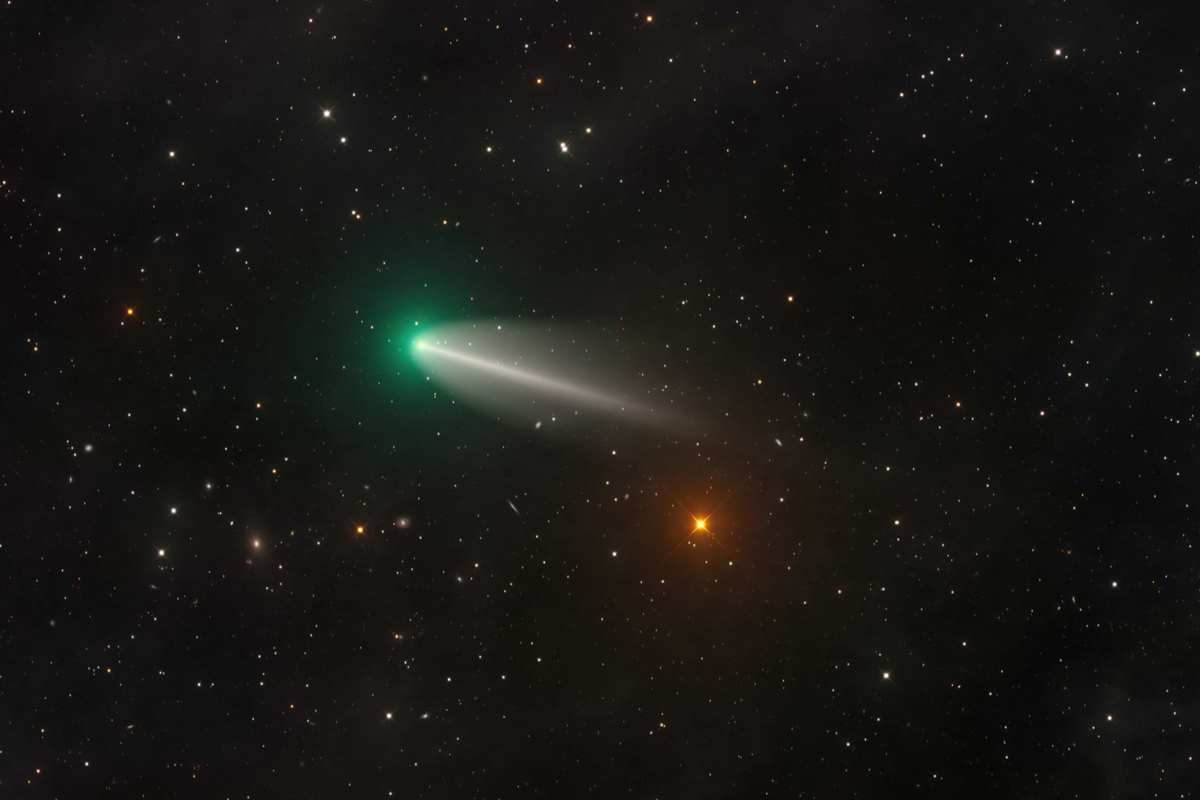
[back] 220P/McNaught (in Cetus)
Big version / Große
Version (9240 x 6323 pixel, 0.743 ”/px )
Annotated Version / Beschriftete Version (9240 x 6323 pixel, 0.743 ”/px )
|
(c) 2026 All astro photo images are copyrighted. They may not be used or reproduced without explicit written permission from the authors. |
|
300" |
|
About this Images / Über dieses Bilder
| Camera: | Moravian C3-PRO-61000 Mono CMOS |
| Image Type, Orientation: | L-RGB composite, North is at 12:00 |
| Exposure time/date: |
August 15th 2026 (2:54-3:55 UT) |
| Location: | Capella Observatory South at Kiripotib Astro Farm, Namibia |
| Filter: | Astronomik Deep-Sky Deep-Sky RGB Filter on Moravian EFW-3L-9-II External Filter Wheel |
| Instrument: | "Rhea", a PlaneWave DeltaRho 350, 1050mm focal length, 350mm aperture, f/3 on 10Micron GM2000 HPS II Combi |
| Photographer: | Rainer Raupach, Josef Pöpsel, Stefan Binnewies, Frank Sackenheim |
|
Remarks: |
Comet 220P/McNaught was discovered
in 2004 by its namesake, Robert McNaught, using data from the Uppsala
Southern Schmidt Telescope. Based on its orbital characteristics, it is
classified as a Jupiter-family comet with an aphelion of 4.68 AU, a
perihelion of 1.68 AU (passed on June 14, 2026), and an orbital period of
approximately 5.5 years. |
|
Bemerkungen: |
Der Komet 220P/McNaught wurde im Jahr 2004 in Daten des
Uppsala Southern Schmidt Teleskops vom Namensgeber Robert McNaught entdeckt.
Er gehört aufgrund seines Orbits zur Jupiter-Familie mit einem Aphel von
4.68 AU, einem Perihel von 1.68 AU (durchlaufen am 14. Juni 2026) und einer
Umlaufzeit von etwa 5.5 Jahren. |
Back to the Comet Overview / Zurück zur Kometen-Übersichtsseite