Annotated Version / Beschriftete Version (9454 x 6303 pixel, 0.743 ”/px )
Image asteroids / Asteroiden im Bild
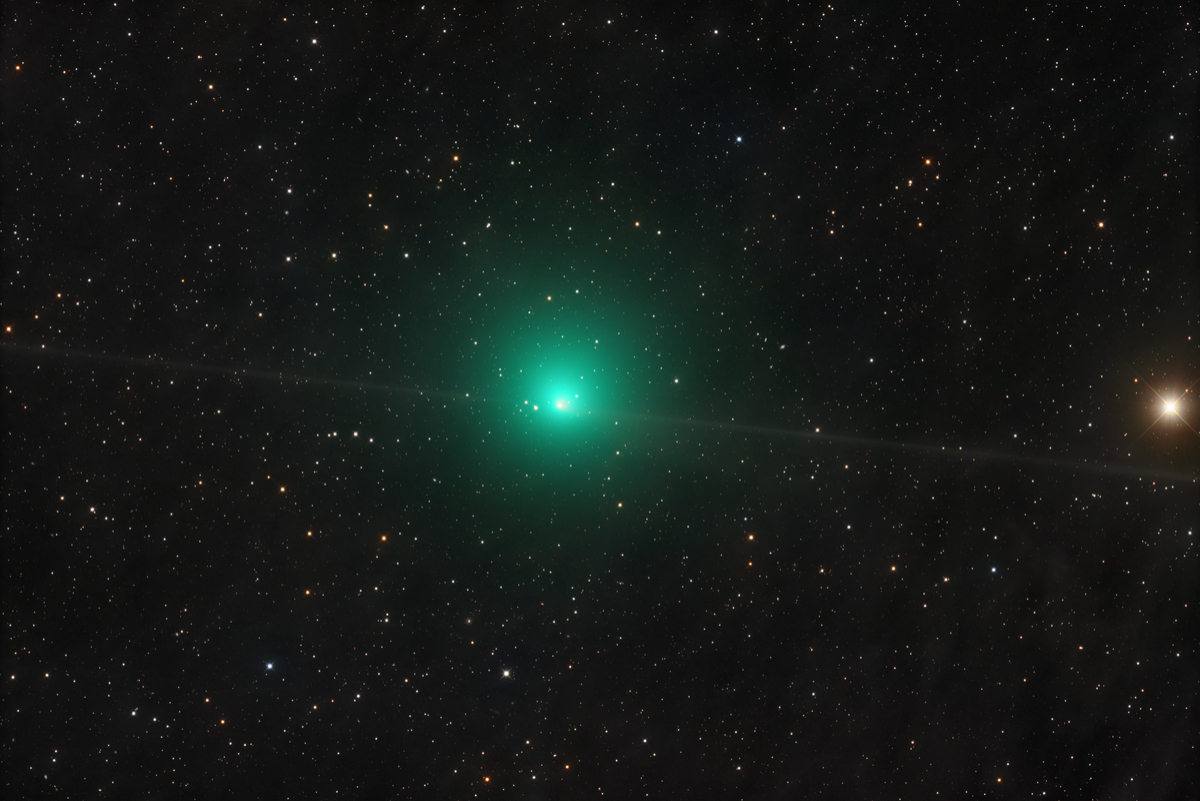
[back] 10P/Tempel (Tempel 2)
Big version / Große
Version (9454 x 6303 pixel, 0.743 ”/px )
Annotated Version / Beschriftete Version (9454 x 6303 pixel, 0.743 ”/px )
Image asteroids / Asteroiden im Bild
|
(c) 2026 All astro photo images are copyrighted. They may not be used or reproduced without explicit written permission from the authors. |
|
300" |
|
About this Images / Über dieses Bilder
| Camera: | Moravian C3-PRO-61000 Mono CMOS |
| Image Type, Orientation: | L-RGB composite, North is at 12:00 |
| Exposure time/date: | July 15th 2026 (0:53-3:42 UT) L: 120 x 30s, RGB: 40/40/40 x 30s (2:00h total) |
| Location: | Capella Observatory South at Kiripotib Astro Farm, Namibia |
| Filter: | Astronomik Deep-Sky Deep-Sky RGB Filter on Moravian EFW-3L-9-II External Filter Wheel |
| Instrument: | "Rhea", a PlaneWave DeltaRho 350, 1050mm focal length, 350mm aperture, f/3 on 10Micron GM2000 HPS II Combi |
| Photographer: | Rainer Raupach, Josef Pöpsel, Stefan Binnewies, Frank Sackenheim |
|
Remarks: |
Comet 10P/Tempel, also known as
Tempel 2, was discovered in 1873. It belongs to the Jupiter-family comets
and has an orbital period of 5.37 years. Its orbit carries it as far as 4.71
AU from the Sun at aphelion, while its perihelion distance is approximately
1.4 AU. During its current apparition, the comet reaches perihelion on
August 2, 2026, and, almost simultaneously, makes its closest approach to
Earth. The image was therefore acquired about two weeks before these events. |
|
Bemerkungen: |
Der Komet 10P/Tempel, auch Tempel 2, wurde im Jahr 1873
entdeckt. Er gehört zur Jupiter-Familie und weist eine Umlaufperiode von
5.37 Jahre auf. Die Bahn führt ihn bis auf 4.71 AU von der Sonne weg, das
Perihel liegt bei ungefähr 1.4 AU. Im aktuellen Umlauf wird das nächste
Perihel am 2. August 2026, und praktisch am gleichen Tag auch die größte
Annäherung an die Erde erreicht. Das Bild wurde folglich etwa zwei Wochen
davor aufgenommen. |
Back to the Comet Overview / Zurück zur Kometen-Übersichtsseite