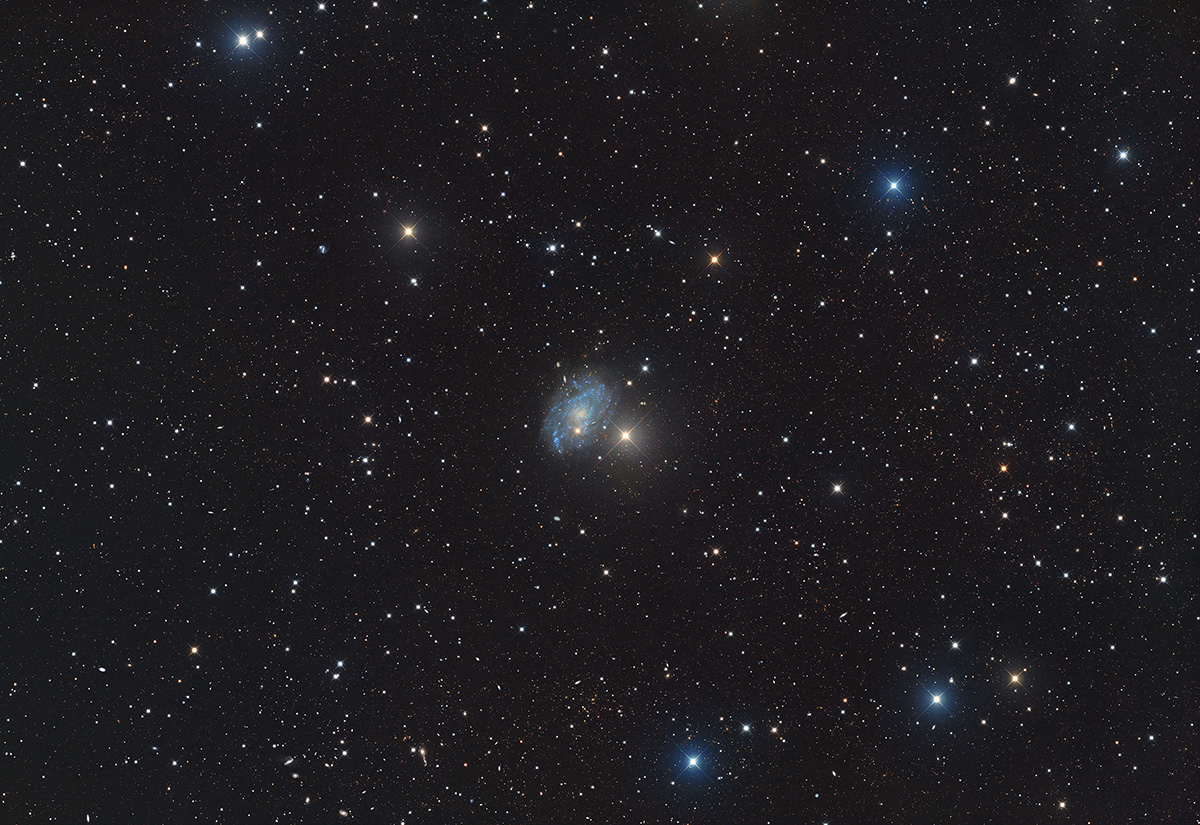
[back] NGC45 in Cetus
Higher resolved image / Höher aufgelöstes LRGB-Bild (5000 x 3436 Pixel)
100% crop of image center / 100%-Ausschnitt des Bildzentrums
Annotated Version / Beschriftete Version
|
|
|
(c) 2026 All astro photo images are copyrighted. They may not be used or reproduced without explicit written permission from the authors
About this Image / Über dieses Bild
| Camera: | Moravian C3-PRO-61000 Mono CMOS |
| Image Type, Orientation: | LRGB-Ha Composite, North is at 12:00 |
| Exposure time: | L: 54x300s, R: 32x300s, G: 32x300s, B: 32x300s, Ha:17x900s (20:00h total) |
| Exposure date: | August 16th...October 10th, 2026 |
| Location: | Capella Observatory South at Kiripotib Astro Farm, Namibia |
| Filter: | Astronomik Deep-Sky Deep-Sky LRGB Filter plus 6nm Ha filter on Moravian EFW-3L-9-II External Filter Wheel |
| Instrument: | "Rhea", a PlaneWave DeltaRho 350, 1050mm focal length, 350mm aperture, f/3 on 10Micron GM2000 HPS II Combi |
| Photographer: | Rainer Raupach, Stefan Binnewies, Josef Pöpsel, Frank Sackenheim |
| Remarks: |
The view of
NGC 45 is obscured by two stars—one with a magnitude of 10.6 and the other
with a magnitude of 6.5—that lie close to and in front of, respectively, the
galactic disk of this SA(s)dm galaxy. This disk, measuring 8.5′ × 5.9′, is
notable for its low surface brightness, which is even lower than that of M
33. NGC 45 is 30 million light-years away, and the maximum transverse disk
diameter is 74,000 light-years. The inner isophotes indicate an inclination
of 55° and a position angle of the major axis of 145°. NGC 45 has no
prominent nucleus, almost no bulge, and its spiral arm pattern consists of
arm fragments. In the lower southern half of the disk, a
Vorontsov–Velyaminov series is visible in the spiral arm extending through
that region. NGC 45 has hardly any dust lanes or condensations, suggesting
that this galaxy’s disk is not only faint but also contains little material.
This transparency is also evident in the translucent and clearly visible
background galaxies. NGC 45 is classified as a “low surface brightness
galaxy” (LSBG). This characteristic is observed in 10–20% of all disk
galaxies. In addition to their low surface brightness, LSBGs are bluer than
comparable Sc-type galaxies and have a much lower star formation rate.
However, their small proportion of newly forming stars is sufficient to make
them appear bluer. |
|
|
|
| Bemerkungen: |
Der Blick auf NGC 45 wird durch zwei 10,6
mag und 6,5 mag helle Sterne behindert, die dicht neben bzw. vor der
galaktischen Scheibe dieser SA(s)dm-Galaxie stehen. Diese 8,5′ × 5,9′ große
Scheibe fällt durch eine geringe Oberflächenhelligkeit auf, deren Wert noch
unter dem für M 33 liegt. NGC 45 ist 30 Millionen Lichtjahre entfernt und
der maximale transversale Scheibendurchmesser beträgt 74.000 Lichtjahre. Aus
den inneren Isophoten ergibt sich eine Inklination von 55° und ein
Positionswinkel der Hauptachse von 145°. NGC 45 besitzt keinen auffälligen
Kern, fast keinen Bulge und das Spiralarmmuster ist aus Armfragmenten
aufgebaut. In der unteren südlichen Scheibenhälfte zeigt sich in dem dort
verlaufenden Spiralarm eine Woronzow-Weljaminow-Reihe. NGC 45 besitzt kaum
Staubbänder oder Verdichtungen, sodass man annehmen kann, dass die Scheibe
dieser Galaxie nicht nur leuchtschwach ist, sondern auch wenig Material
enthält. Diese Durchsichtigkeit zeigt sich ebenso in den durchscheinenden
und gut erkennbaren Hintergrundgalaxien. NGC 45 zählt zu den „low surface
brightness galaxies“ (LSBG). Diese charakteristische Eigenschaft beobachtet
man bei 10–20 % aller Scheibengalaxien. Neben der geringen
Oberflächenleuchtkraft sind LSBGs blauer als vergleichbare Sc-Typen und
besitzen eine viel geringere Sternentstehungsrate. Ihr geringer Anteil an
neu entstehenden Sternen reicht aber aus, um sie blauer erscheinen zu
lassen. |
Back to the Galaxies' Overview / Zurück zur Galaxien-Übersichtsseite