|
Remarks: |
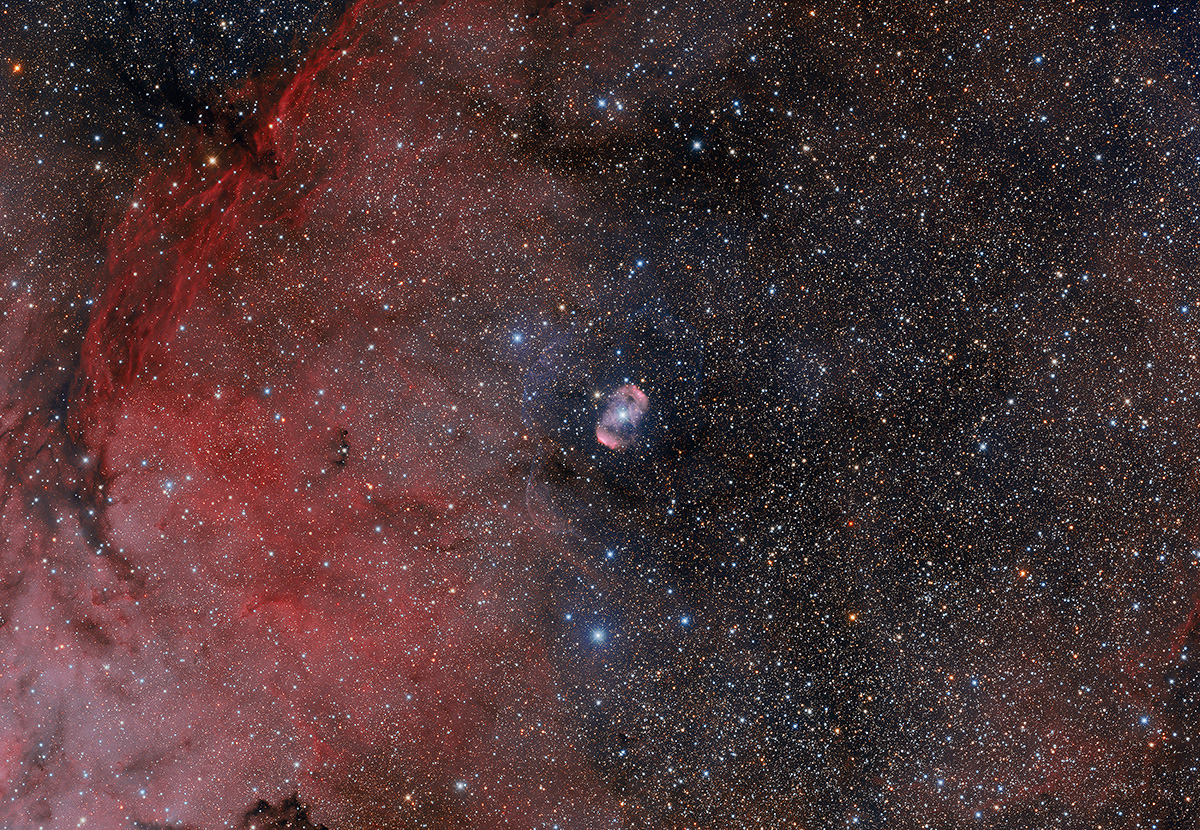
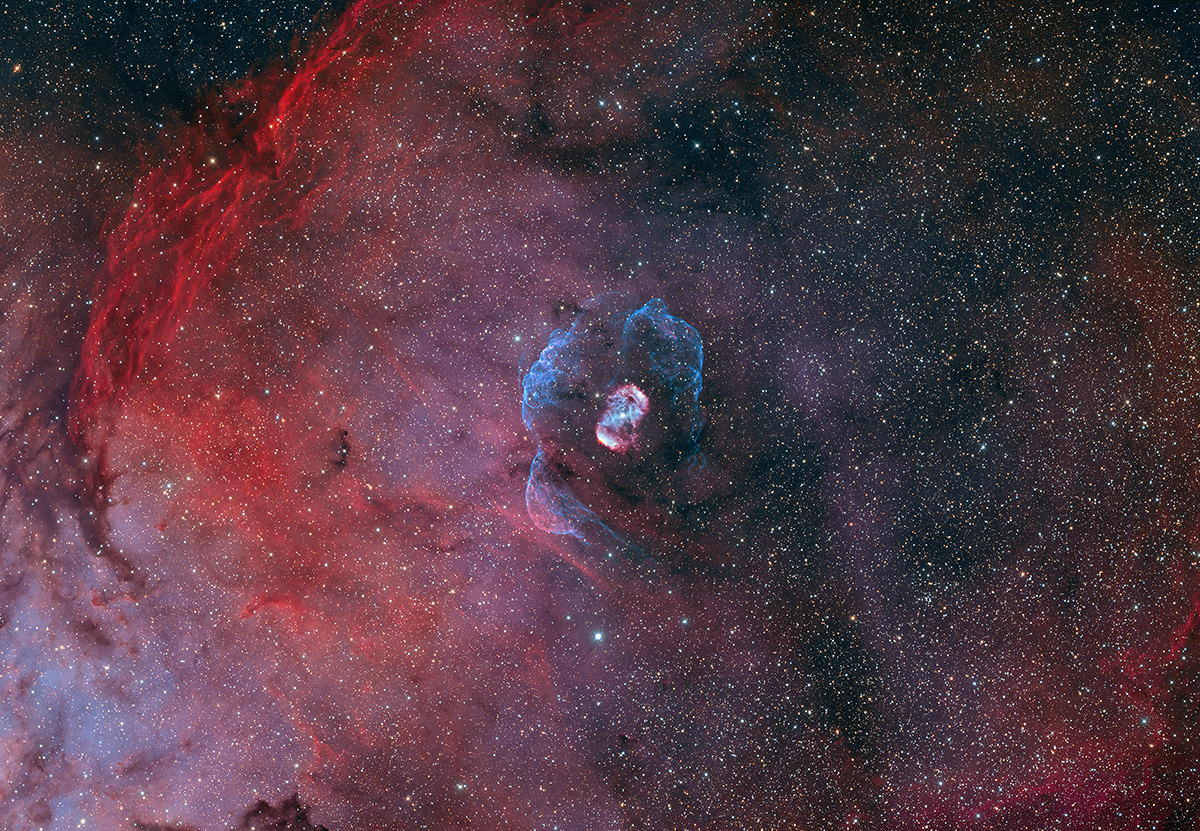
In the image, NGC 6164 is located in
the upper, northern part of the nebula, and NGC 6165 is at the bottom. Both
of these red-glowing NGC objects are parts of the bipolar emission nebula
produced by the star HD148937, which is at the center of the image.
HD148937 is 3,875 ± 100 light-years away from us, and its Gaia color index
is GBP-GRP = 0.53 mag. The angular separation between the two NGC ends is
measured at 5.6', which yields a projected distance of 6.3 light-years.
The brilliantly bright star HD148937 is an O6f?p star. These spectral types
are rare and indicate the presence of active magnetic fields. The first of
these magnetic O-type stars was discovered in 2002; today, only a handful of
such special blue supergiants are known. Within the small group of magnetic
O-type stars, HD148937 is the hottest, with a temperature of 41,000 K. It is
believed that these are main-sequence stars possessing a pronounced dipole
magnetic field whose strength exceeds 20 kGauss. By comparison, the magnetic
field strength on the Sun’s surface is about 0.1 kGauss. In individual
sunspots, the Sun generates magnetic field strengths of 4 kGauss, making it
10,000 times stronger than Earth’s magnetic field. In the optical spectral
lines of HD148937, the magnetic fields cause variability with a period of
7.03 days.
Among the magnetic O-type stars, no other star has a nebula. One possible
reason for this could be its “binarity,” that is, its status as a binary
star. Researchers suspect that HD148937 is a spectroscopic binary. When
models are fitted to the spectrum, a good solution is obtained with masses
of 49 solar masses and 34 solar masses and an inclination of about 40° (at
0°, we would be looking directly at the orbital plane). Both stars are
O-type and contribute similarly to the spectrum. It appears that the less
massive star possesses the stronger magnetic field, and its rotation may
also explain the observed 7.03-day period. The orbital period of the two
O-type stars—9,591 days—is so long that it has no influence on the spectra.
Assuming a binary star system, the strikingly precise bipolarity of the
nebula can be plausibly explained. The condensations at the NGC ends are
precisely mirrored by the star and demonstrate the strict symmetry of the
magnetic processes that controlled the outflow of the stellar winds. In
addition, the dipole field of one of the components points away from the
orbital plane. This allows us to calculate that the emission nebula could
have formed 600,000 years ago during a strong stellar wind event.
Since an ellipsoidal [OIII] gas bubble - about five times larger but much
fainter - can be detected outside NGC 6164/5, and its major axis also aligns
with the polar orientation, one might speculate whether such an event had
already occurred previously. That event would then have taken place about
1.2 million years ago. Even though questions remain, it is clear that
stellar wind episodes account for a significant portion of these stars’
short lifetimes - the lifetime of the magnetic component in HD148937 is only
about 5 million years.
An image of the center part done at f=4800mm in 2004 can be found
here.
Text from the “Bildatlas der Sternhaufen und
Nebel v. Michael König u. Stefan Binnewies“ (KOSMOS Verlag) |
|
Bemerkungen: |
Auf der Aufnahme findet man NGC 6164 im oberen,
nördlichen Teil des Nebels, und NGC 6165 steht unten. Beide rot leuchtenden
NGC-Objekte sind Teile des bipolaren Emissionsnebels, den der Stern HD148937
im Bildzentrum produziert hat.
HD148937 ist 3.875 ± 100 Lichtjahre von uns entfernt und sein Gaia-Farbindex
liegt bei GBP-GRP = 0,53 mag. Der Winkelabstand der zwei NGC-Enden misst man
zu 5,6‘ und daraus errechnet sich ein projizierter Abstand von 6,3
Lichtjahren.
Bei dem strahlend hellen Stern HD148937 handelt es sich um ein O6f?p-Stern.
Diese Spektraltypen treten selten auf und verweisen auf wirkende
Magnetfelder. Der erste dieser magnetischen O-Sterne wurde 2002 gefunden,
heute kommt man auf eine Handvoll solcher besonderer blauer Überriesen. In
der kleinen Gruppe der magnetischen O-Sterne ist HD148937 mit einer
Temperatur von 41.000 K der heißeste. Man vermutet, dass es sich bei ihnen
um Hauptreihensterne handelt, die ein ausgeprägtes Dipolmagnetfeld
aufweisen, dessen Stärke über 20 kGauß hinausreicht. Im Vergleich dazu liegt
die Stärke des Magnetfelds auf der Sonnenoberfläche bei etwa 0,1 kGauß. In
einzelnen Sonnenflecken schafft die Sonne Magnetfeldstärken von 4 kGauß und
ist damit 10.000-fach stärker als Erdmagnetfeld. In den optischen
Spektrallinien von HD148937 bewirken die Magnetfelder eine Variabilität mit
einer Periode von 7,03 Tagen.
In der Gruppe der magnetischen O-Sterne besitzt kein anderer Stern einen
Nebel. Eine Ursache dafür könnte in der „binarity“, also in der
Doppelsternnatur liegen. Die Forscher vermuten bei HD148937 einen
spektroskopischen Doppelstern. Passt man Modelle an das Spektrum an, so
ergibt sich eine gute Lösung bei 49 Sonnenmassen und 34 Sonnenmassen und
einer Inklination von etwa 40° (bei 0° würden wir frontal auf die Bahnebene
blicken). Beide Sterne sind O-Typen und liefern ähnliche Beiträge im
Spektrum. Es sieht so aus, als wenn der masseärmere Stern das größere
Magnetfeld besitzt und dessen Rotation auch die gefundene 7,03 Tagesperiode
erklären kann. Die Umlaufzeit der zwei O-Sterne ist mit 9.591 Tagen so groß,
dass sie keinen Einfluss auf die Spektren hat.
Geht man von einem Doppelsternsystem aus, so kann man die auffallend exakte
Bipolarität des Nebels verständlich erklären. Die Verdichtungen in den
NGC-Enden lassen sich genau am Stern spiegeln und belegen die strenge
Symmetrie der magnetischen Prozesse, die das Abströmen der Sternwinde
gesteuert haben. Dazu kommt, dass das Dipolfeld der einen Komponenten aus
der Bahnebene heraus weist. Damit kann berechnen, dass der Emissionsnebel so
vor 600.000 Jahren bei einem starken Sternwindereignis entstanden sein
könnte.
Da man außerhalb von NGC 6164/5 noch eine etwa fünfmal größere, aber viel
schwächere ellipsoide [OIII]-Gasblase nachweisen kann, deren Hauptachse auch
zur polaren Ausrichtung passt, kann man spekulieren, ob es nicht schon zuvor
ein solches Ereignis gegeben hat. Dieses läge dann etwa 1,2 Mio. Jahre
zurück. Auch wenn Fragen offenblieben, erkennt man doch, dass die
Sternwindepisoden bei diesen Sternen einen großen Zeitraum in ihrer kurzen
Existenz ausmachen – die Lebenszeit der magnetischen Komponente in HD148937
liegt bei nur rund 5 Mio. Jahren.
Ein Bild vom Zentrum bei f=4800mm aus dem Jahr 2004 ist
hier zu finden.
Text aus dem Bildatlas der Sternhaufen und Nebel v. Michael
König u. Stefan Binnewies (KOSMOS Verlag) |