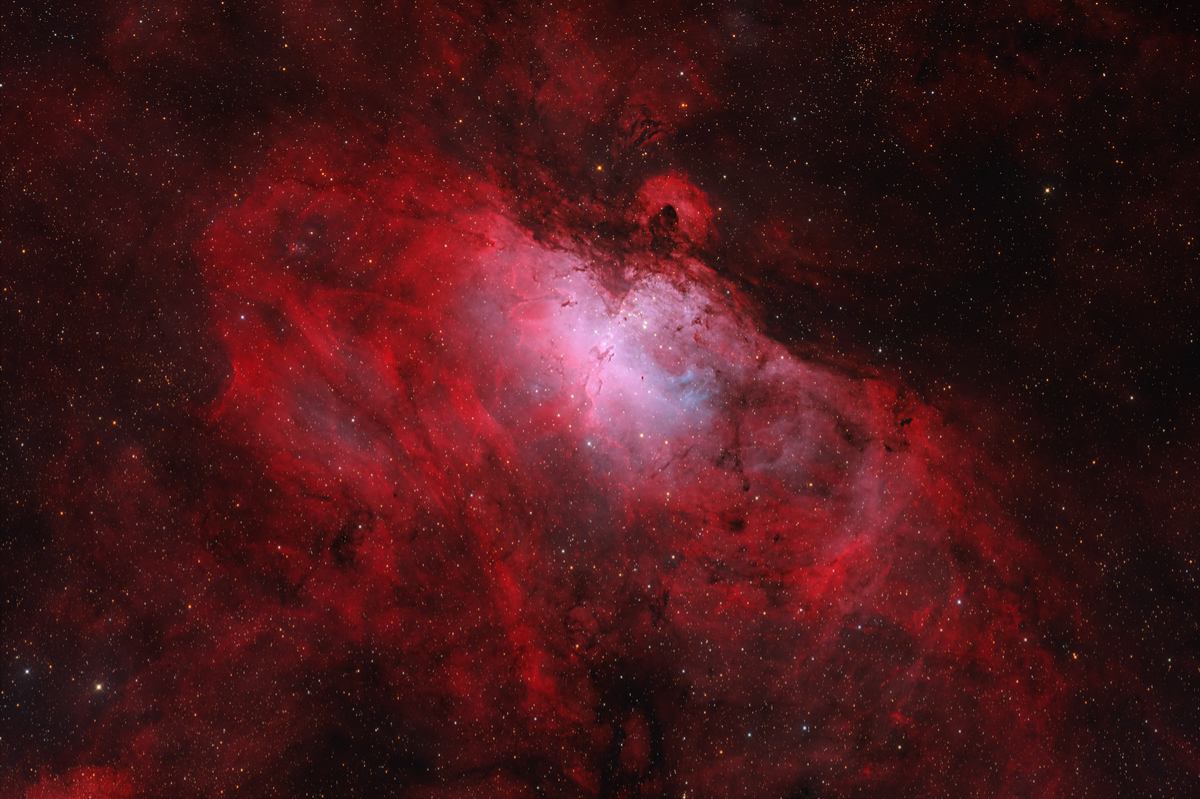
[back] M 16 (Eagle Nebula/Adler Nebel) in Serpens [NED]
100%
image SHORGB-version / 100% Bild SHORGB-Version (9484 x 6310, 0.743"/pixel)
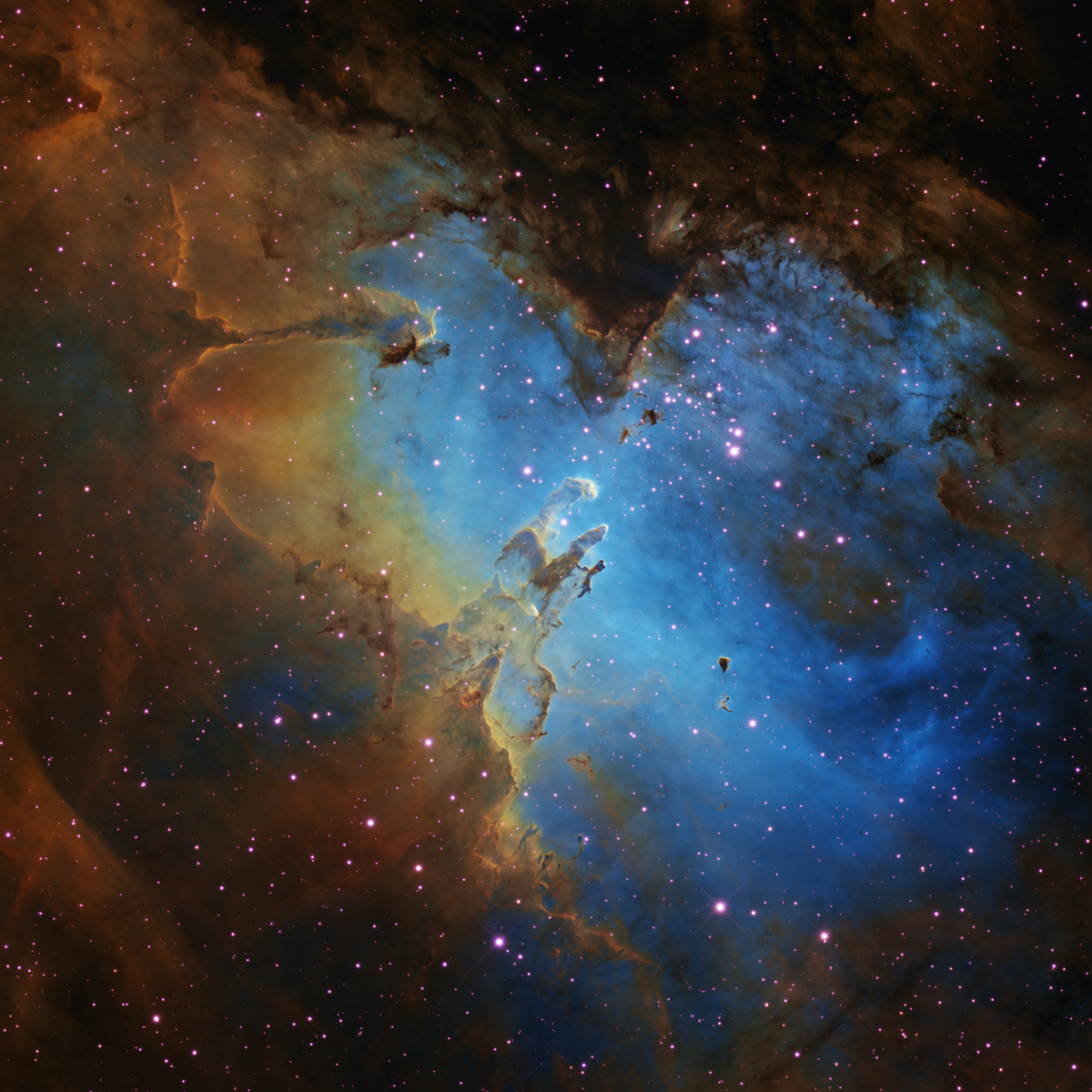
Cropped SHO-Hubble
palett version / Beschnittene SHO-Hubble-Version (2048 x 2048 pixel)
Cropped SHO-Hubble
palette version with RGB stars / Beschnittene SHO-Hubble-Version mit
RGB-Sternen (2048 x 2048 pixel)
Annotated 100%
image SHORGB-version / Beschriftete 100% Bild SHORGB-Version (9484 x 6310, 0.743"/pixel)
Annotated croped SHO-Hubble palett version / Beschriftete beschnittene SHO-Hubble-Version (2048
x 2048 pixel)
|
(c) 2026 All astro photo images are copyrighted. They may not be used or reproduced without explicit written permission from the authors. |
|
300" |
|
Croped SHO-Hubble palette version / Beschnittene SHO-Hubble-Version
|
(c) 2026 All astro photo images are copyrighted. They may not be used or reproduced without explicit written permission from the authors. |
|
60" |
|
About this Images / Über dieses Bilder
| Camera: | Moravian C3-PRO-61000 Mono CMOS |
| Image Type, Orientation: | SHORGB composite (upper image) and Hubble palette false color (lower image), North is at 12:00 |
| Exposure time/date: | May 11th...25th 2026 RGB: 18/18/18 x 300 s, SII: 20 x 900 s, Ha: 20 x 900 s, OIII: 20 x 900 s (19:30h total) |
| Location: | Capella Observatory South at Kiripotib Astro Farm, Namibia |
| Filter: | Astronomik Deep-Sky Deep-Sky RGB Filter plus 6nm SII,Ha,OIII filter on Moravian EFW-3L-9-II External Filter Wheel |
| Instrument: | "Rhea", a PlaneWave DeltaRho 350, 1050mm focal length, 350mm aperture, f/3 on 10Micron GM2000 HPS II Combi |
| Photographer: | Rainer Raupach, Josef Pöpsel, Stefan Binnewies, Frank Sackenheim |
|
Remarks: |
Messier 16, widely known as the
Eagle Nebula, is a prominent emission nebula situated in the constellation
Serpens, inextricably linked with the central open cluster NGC 6611. The
ionization and excitation driving this vibrant emission are fueled by
massive, hot stars with an average age of merely 800.000 years.
Concurrently, the nebula functions as an active star-forming region,
destined to evolve over cosmic time into a more expansive open stellar
cluster. |
|
Bemerkungen: |
Messier 16, auch als Adlernebel bekannt, ist ein
bekannter Emissionsnebel im Sternbild Schlange, der mit dem zentralen
offenen Sternhaufen NGC 6611 steht. Die im Mittel nur etwa 800000 Jahre
alten, heißen Sterne sind für die Ionisation und Anregung der Emission
verantwortlich. Gleichzeitig stellt der Nebel eine Sternentstehungsregion
dar und wird sich in im Laufe der Zeit in einem größeren offenen Sternhaufen
umwandeln. |
Back to the Diffuse Nebulae Overview / Zurück zur Diffuse-Nebel-Übersichtsseite