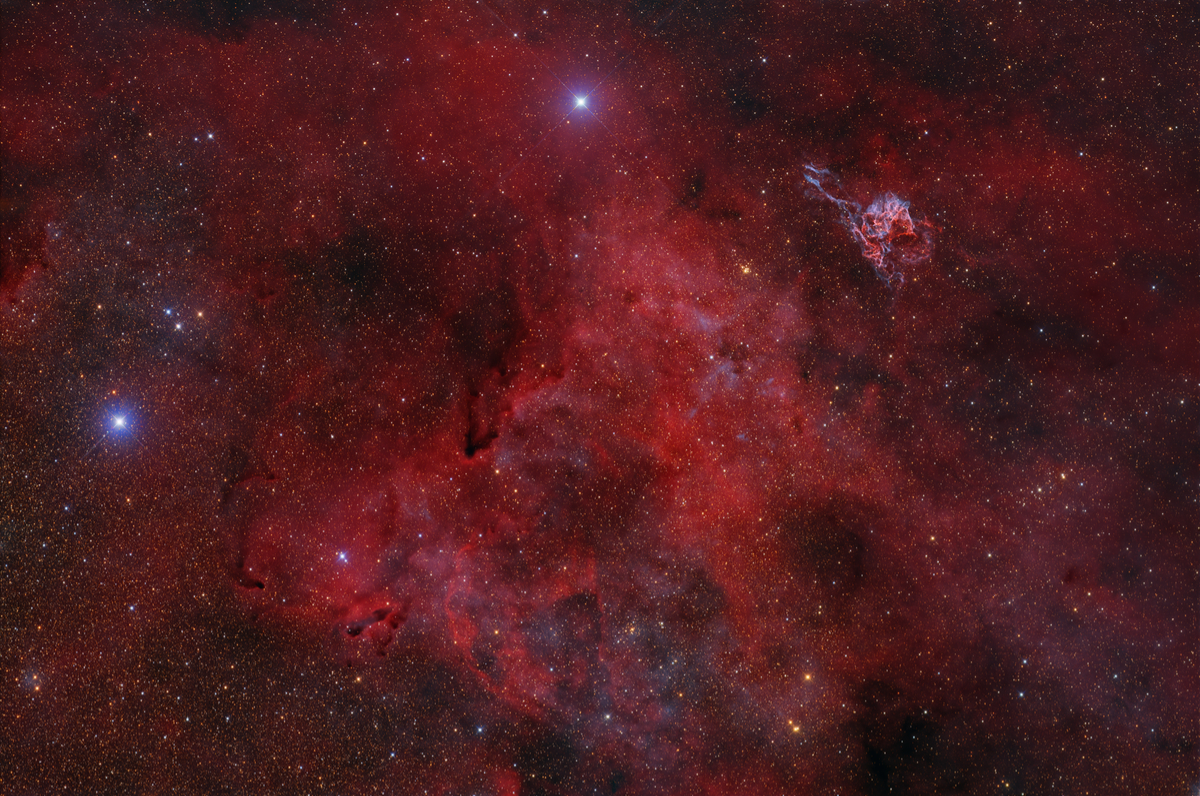
[back] SNR G320.6-01.6 & SNR G320.4-01.2 (incl. RCW 89) in Circinus

Higher resolved image / höher aufgelöstes Bild (9490 x 6201 pixel, 0.743 ”/pixel )
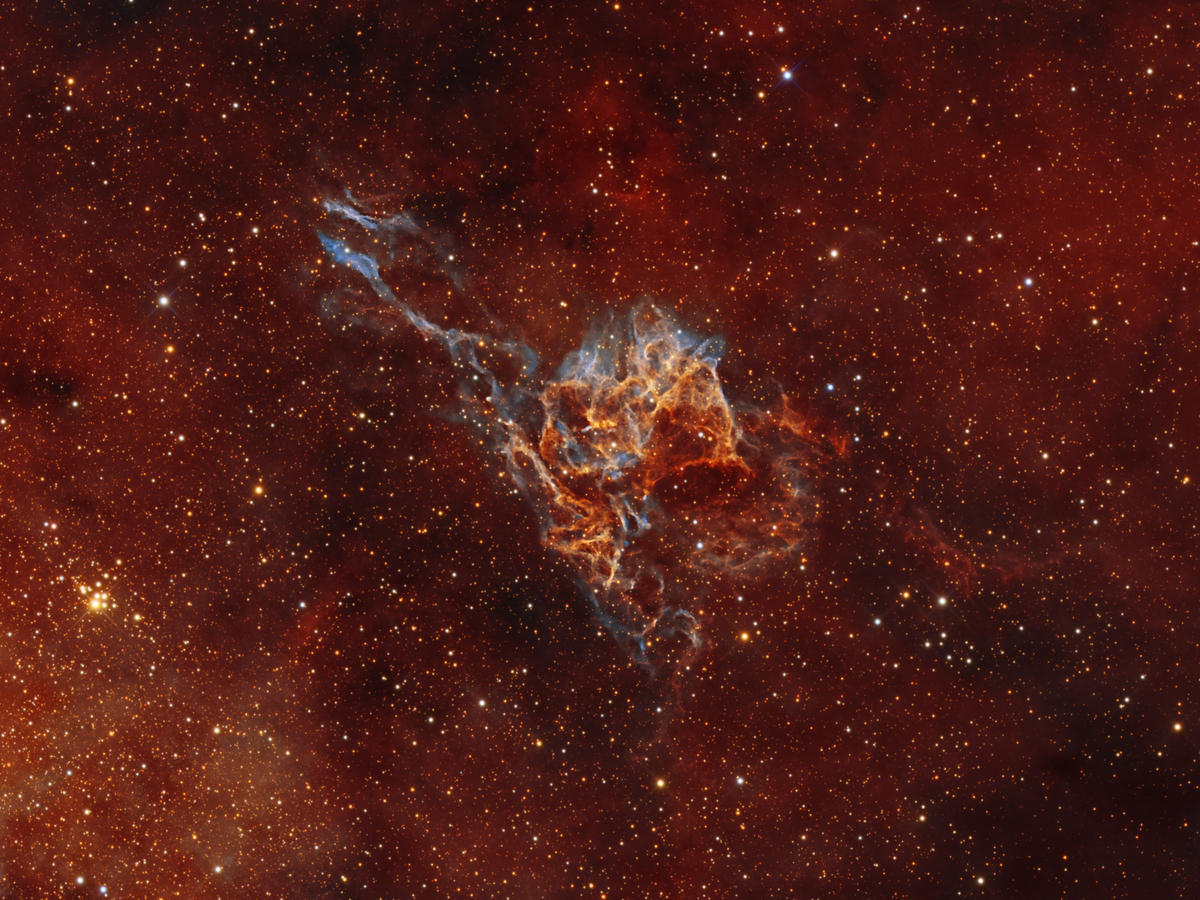
High resolved croped image (Foraxx version)/ Hoch aufgelößter Ausschnitt (Foraxx-Version) (2480 x 1860 pixel)
Annotated version / Annotierte Version (9490 x 6201 pixel)

5'


(c) 2025 All astro photo images are copyrighted. They may not be used or reproduced without explicit written permission from the authors.


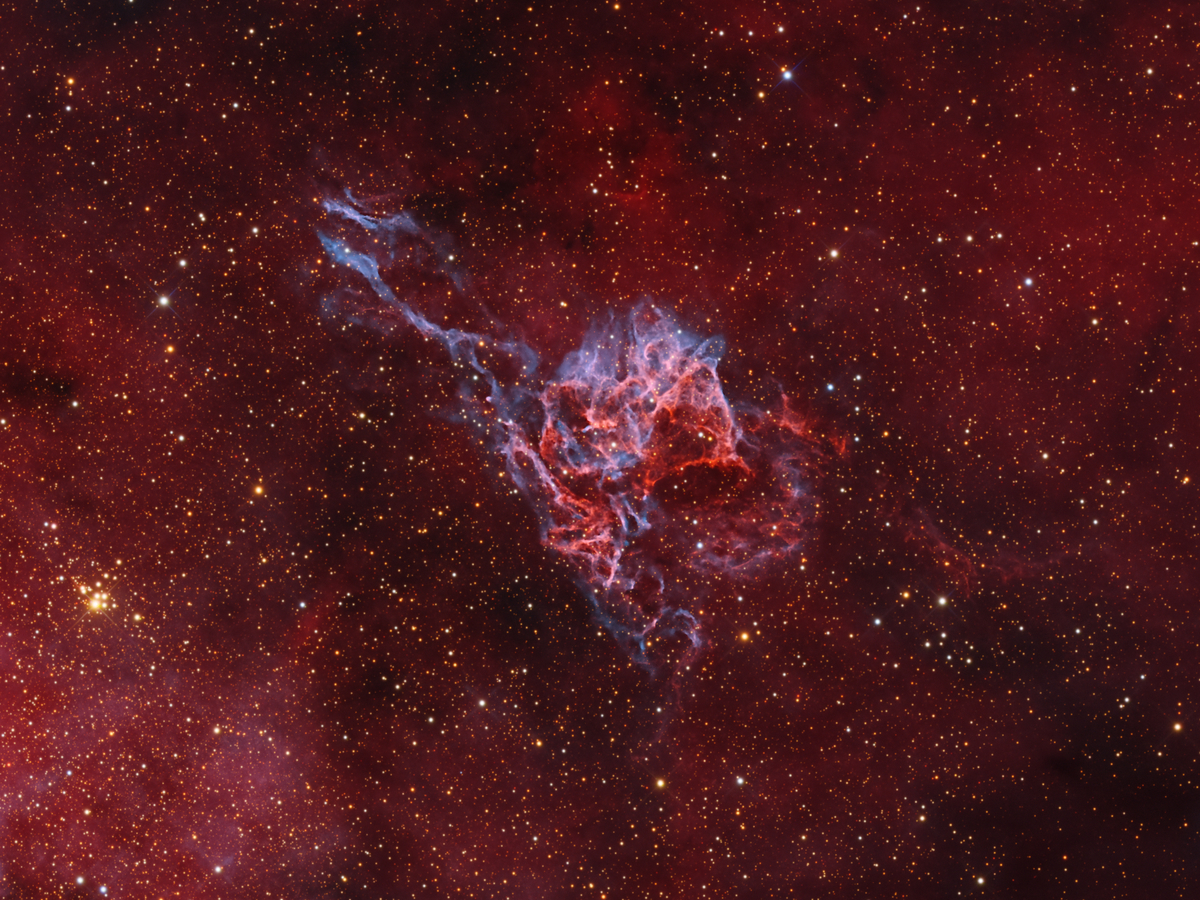
Cropped area around RCW 89/ Ausschnitt um RCW 89
(c) 2025 All astro photo images are copyrighted. They may not be used or reproduced without explicit written permission from the authors.


Cropped area around RCW 89 (Foraxx version)/ Ausschnitt um RCW 89 (Foraxx-Version)
(c) 2025 All astro photo images are copyrighted. They may not be used or reproduced without explicit written permission from the authors.


About this Image / Über dieses Bild

Camera: Moravian C3-PRO-61000 Mono CMOS
Image Type, Orientation: RGB-SIIHaOIII Color Composite, North is at 12:00
Exposure time: RGB: 18/18/18 x 300s, SII: 20 x 900s, H-alpha: 20 x 900s, OIII: 20 x 900s (19:30h total)
Exposure date: June 1st...June 29th, 2025
Location: Capella Observatory South at Kiripotib Astro Farm, Namibia
Filter: Astronomik Deep-Sky Deep-Sky RGB Filter  plus 6nm SII, Ha, OIII filters on Moravian EFW-3L-9-II External Filter Wheel
Instrument: "Rhea", a PlaneWave DeltaRho 350, 1050mm focal length, 350mm aperture,  f/3 on 10Micron GM2000 HPS II Combi
Photographer: Rainer Raupach, Josef Pöpsel, Frank Sackenheim, Stefan Binnewies
   
Remarks:

The present image, located in the constellation Circinus, contains at its center the supernova remnant (SNR) G320.6−01.6, and, overlapping toward the northwest, another supernova remnant, G320.4−01.2.
The latter hosts the central pulsar PSR B1509−58 (J1513−5908), which powers a pulsar wind nebula. The immediate vicinity of the pulsar is most prominent at X-ray wavelengths [1], while its optical counterpart is formed by the emission nebula RCW 89, characterized by typical filamentary structures. Southeastern [O III] filaments may also be associated with the pulsar wind nebula, although they are partially obscured by intervening gas and molecular clouds.
In the neighboring open cluster Pişmiş 20, which contains, among other members, blue supergiants, the effects of extinction are clearly evident through the pronounced reddening of its stars. Since the cluster lies at a distance of approximately 9,000 light-years [2] — about half the distance to the pulsar (~17,000 light-years) — the material causing the extinction must be located in the foreground, closer to us.
The centrally placed SNR G320.6−01.6 appears significantly larger in projection, but at a distance of roughly 10,000 light-years [3], it is also nearer than the pulsar. Whether the observed emission [a] is excited by shock waves from the SNR or — particularly in the southeast — partially stimulated by WR 68 cannot be determined from the image alone.

[a] All narrowband data have undergone continuum subtraction. The signal visible in the image therefore predominantly represents the intensity of the corresponding emission line.

   
Bemerkungen:

Das vorliegende Bild im Sternbild Zirkel (Circinus) beherbergt den zentral liegenden Supernova-Überrest (SNR) G320.6-01.6 und mit diesem überlappend in Richtung Nord-West einen weiteren Supernova-Überrest G320.4-01.2.
Letzter weist den zentral liegenden Pulsar PSR B1509-58 (J1513-5908) auf, der einen Pulsarwind-Nebel erzeugt. Die direkte Nachbarschaft des Pulsars ist vor allem im Röntgen-Wellenlängenbereich sichtbar [1], während eine optische Komponente durch den Emissionsnebel RCW 89 mit typischen Filamenten gebildet wird. Möglichweise gehören auch südöstlich des Pulsars gelegene OIII-Filamente zum Pulsarwind-Nebel, sind aber teilweise von davorliegenden Gas- und Molekülwolken verdeckt. Am benachbarten Sternhaufen Pişmiş 20, der unter anderem blaue Überriesen enthält, ist die Extinktion durch starke Rötung derer Mitglied-Sterne klar zu erkennen. Da der Sternhaufen mit ~9000 Lichtjahren [2] nur etwa halb so weit wie der Pulsar (~17000 Lichtjahre) entfernt ist, muss sich die Materie, die die Extinktion verursacht noch näher zu uns befinden.
Der zentral im Bild liegende SNR G320.6-01.6 ist scheinbar deutlich größer, liegt jedoch mit ~10000 Lichtjahren [3] auch näher zu uns. Ob die Emission [a] durch Stoßwellen des SNR angeregt wird, oder insbesondere im Südosten teilweise von WR 68 stimuliert wird, lässt sich anhand des Bildes nicht beantworten.

[a] Alle aufgenommen Schmalband-Daten wurden einer Kontinuum-Subtraktion unterzogen. Das im Bild sichtbare Signal ist daher zu einem hohen Grad Intensität der entsprechenden Emissionslinie.

   
References: [1] X-ray: NASA/CXC/Stanford Univ. /R. Romani et al. (Chandra); NASA/MSFC (IXPE); inframerah: NASA/JPL-Caltech/DECaPS; Pemrosesan Gambar: NASA/CXC/SAO/J. Schmidt,
https://commons.wikimedia.org/wiki/File:Snapinsta.app_397126185_717441716413533_2780853355255994623_n_1080.jpg

[2] Gaia DR3 query: https://gea.esac.esa.int/archive/

[3] Wang et al. (A&A 2020): https://www.aanda.org/articles/aa/pdf/2020/07/aa36868-19.pdf

Back to the Supernovae-Remnants Overview / Zurück zur Supernovae-Überreste-Übersichtsseite