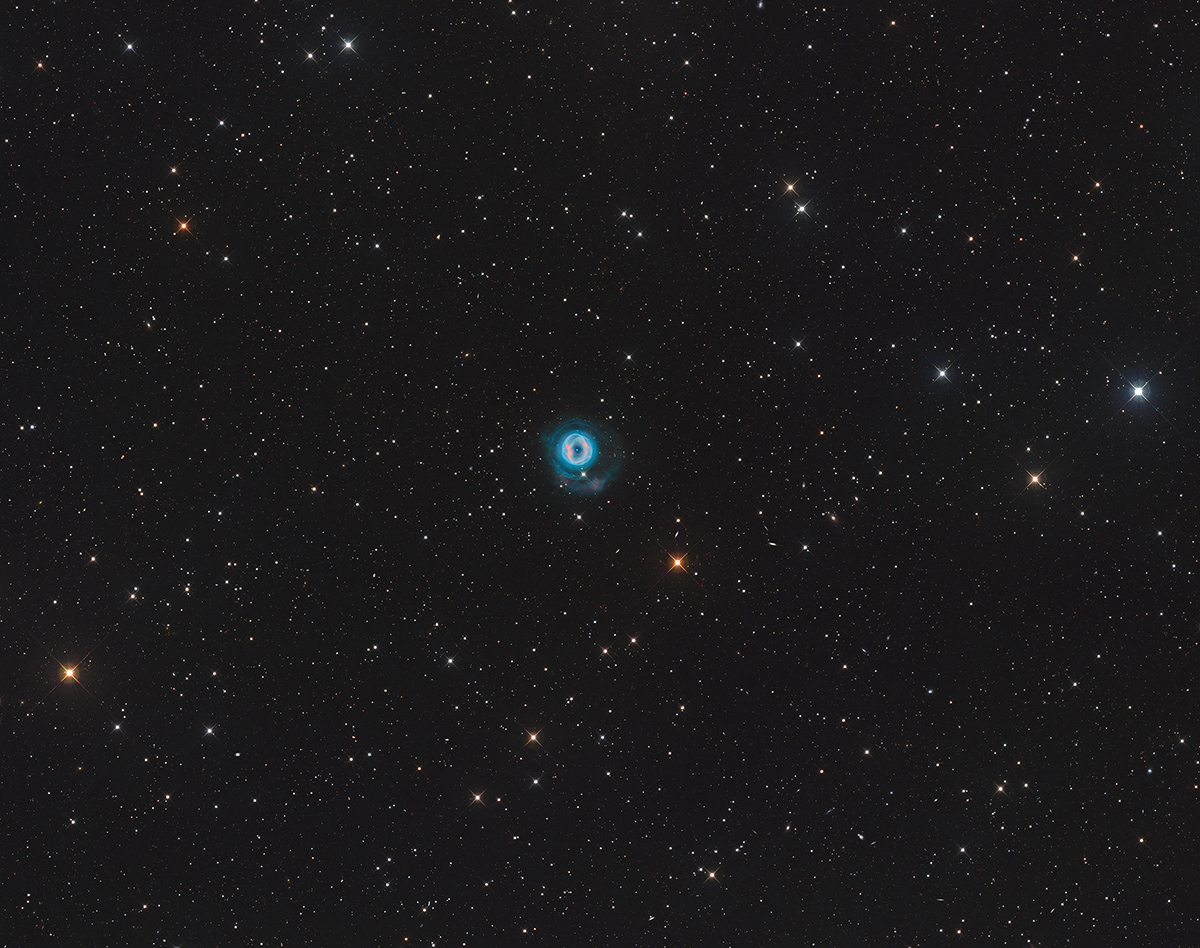
Higher resolved image / Höher aufgelöstes
Bild (5000 x 3948)
Higher resolved image
center/ Höher aufgelöste
Bildmitte (2480 x1860)
|
(c) 2025 All astro photo images are copyrighted. They may not be used or reproduced without explicit written permission from the authors. |
|
300" |
|
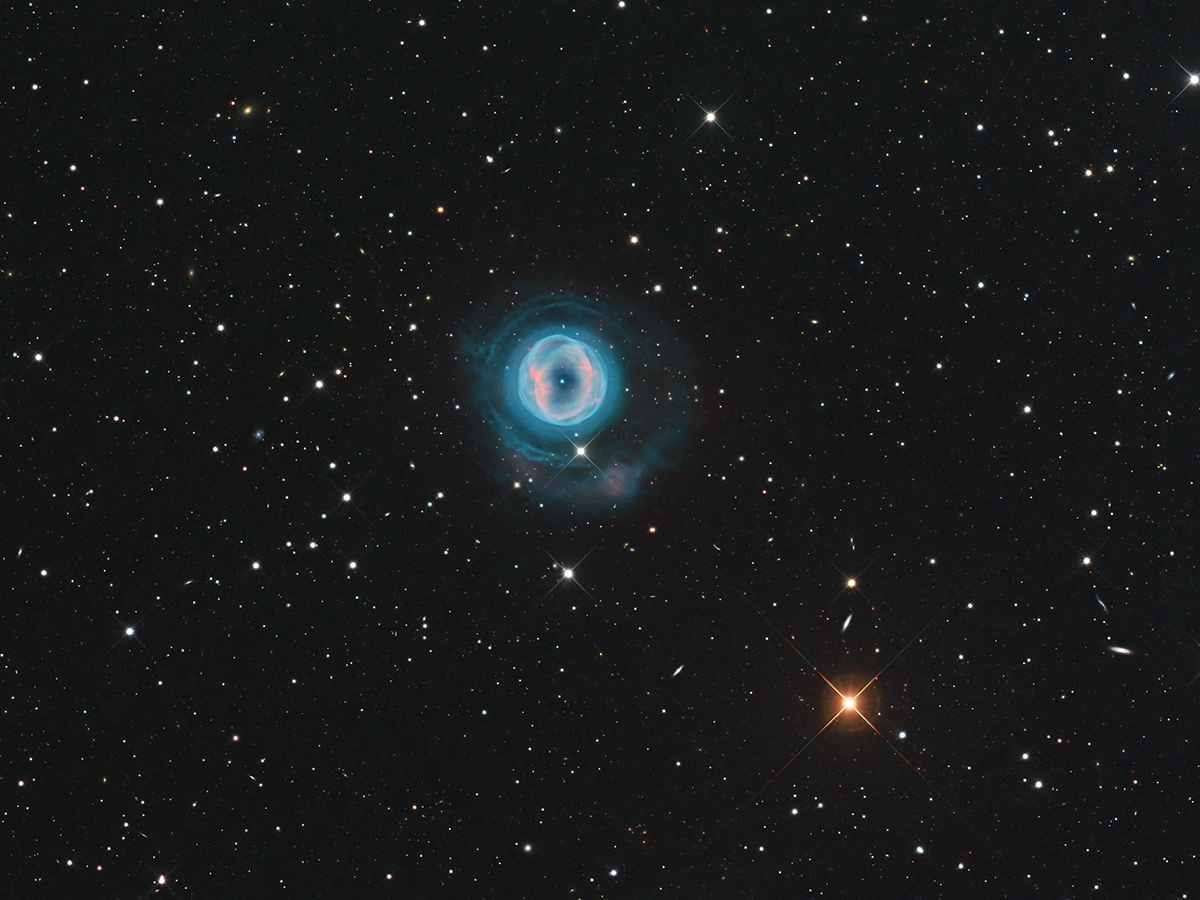
100% Crop of the PN / 100% Ausschnitt des PN
|
(c) 2025 All astro photo images are copyrighted. They may not be used or reproduced without explicit written permission from the authors. |
|
300" |
|
About this Image / Über dieses Bild
| Camera: | Moravian C3-PRO-61000 Mono CMOS |
| Image Type, Orientation: | (RGB-)SHO Color Composite, North is at 12:00 |
| Exposure time: | RGB: 30/29/28 x 300s, H-alpha: 19 x 900s, OIII: 20 x 900s (17:00h total) |
| Exposure date: | October 13th... November 11th, 2025 |
| Location: | Capella Observatory South at Kiripotib Astro Farm, Namibia |
| Filter: | Astronomik Deep-Sky Deep-Sky RGB Filter plus 6nm Ha,OIII filter on Moravian EFW-3L-9-II External Filter Wheel |
| Instrument: | "Rhea", a PlaneWave DeltaRho 350, 1050mm focal length, 350mm aperture, f/3 on 10Micron GM2000 HPS II Combi |
| Photographer: | Rainer Raupach, Stefan Binnewies, Josef Pöpsel, Frank Sackenheim |
| Remarks: |
The planetary nebula IC 5148 is listed in Johan L. E.
Dreyer's “Second Index Catalogue of Nebulae and Clusters of Stars” from 1910
with both the number IC 5148 and the number IC 5150. This is due to two
independent discoveries made by Edward D. Swift in 1897 and Walter F. Gale
in 1894. However, both had inaccurate positions with an error of several
arcminutes, resulting in the double IC entry. It was not until 1961 that
Cuno Hoffmeister was able to clarify unequivocally that it was one and the
same object. IC 5148 is located in the constellation Grus (the Crane) and
can be seen in the image as a nebula shell approximately 2.3′ in size. The
brightness of the nebula is 12 mag, which explains Gale's note “pretty
bright, pretty large, annular,” which he made after observing it with the
22-cm refractor at the Sydney Observatory. The central star in IC 5148 has
the catalog entry Gaia DR2 6574225217863069056. Its distance is 3810 ± 240
light-years, its brightness in the Gaia G band is 16.1 mag, and its color
index is GBP–GRP = –0.59 mag. In the circular central disk, we can see two
bright rings with a smaller diameter than the outer edge of the shell, but
they are not concentric; instead, they are shifted in a north-south
direction. This causes the observer to see a deviation from circular
symmetry. At the point where the two rings overlap, we can see yellowish
brightening in the image. In the spectrum of IC 5148, the [OIII] emission is
the most prominent and about ten times more intense than Hα. This is
followed by Hβ, HeII, and HeI. All emissions are about an order of magnitude
more intense in the outer half of the nebula than in the inner half. The
[OIII] dominance is an indicator of highly ionized gas, which can also be
detected in an extremely faint halo surrounding the shell as a concentric
arc, which could be clearly imaged here thanks to the long exposure.
However, the [OIII] prominence cannot be explained solely by photoionization
from the white dwarf in the center, which is about 130,000 K hot.
Astronomers see a possible connection here with the rings in the nebula
envelope. These are likely to be due to shock fronts triggered by the
ejection of the outer regions of a predecessor star with a mass of about 1.5
solar masses. In this model, the afterglow of the expanding shock fronts
would be a selective amplifier of the [OIII] emission. If this were the
case, we would currently be observing the planetary nebula IC 5148 in its
“blue phase.” An older version of the PN done with Ganymed in 2003 can be found here. |
|
|
|
| Bemerkungen: |
Der planetarische Nebel IC 5148 wird im „Second Index Catalogue of Nebulae and Clusters of Stars“ von Johan L. E. Dreyer aus dem Jahr 1910 sowohl mit der Nummer IC 5148 als auch mit der Nummer IC 5150 geführt. Dies geht auf zwei voneinander unabhängige Entdeckungen zurück, die 1897 durch Edward D. Swift und 1894 durch Walter F. Gale erfolgten. Bei beiden war die Position aber ungenau und mit einem Fehler von einigen Bogenminuten behaftet, so dass es zum IC-Doppeleintrag kam. Erst 1961 konnte Cuno Hoffmeister eindeutig klären, dass es sich um ein und dasselbe Objekt handelt. IC 5148 liegt im Sternbild Kranich (Grus) und ist auf der Aufnahme als etwa 2,3′ große Nebelhülle zu erkennen. Die Helligkeit des Nebels beträgt 12 mag und macht die Notiz von Gale „pretty bright, pretty large, annular“ („ziemlich hell, ziemlich groß, kreisförmig“) verständlich, die er nach der Beobachtung am 22-cm-Refraktor des Sydney-Observatoriums anfertigte. Der Zentralstern in IC 5148 hat den Katalogeintrag Gaia DR2 6574225217863069056. Seine Entfernung beträgt 3810 ± 240 Lichtjahre, seine Helligkeit im Gaia-G-Band liegt bei 16,1 mag und der Farbindex ist GBP–GRP = –0,59 mag. In der kreisförmigen zentralen Scheibe erkennen wir zwei helle Ringe mit geringerem Durchmesser als der Außenrand der Hülle, die aber nicht konzentrisch liegen, sondern in Nord-Süd-Richtung verschoben sind. Dadurch sieht ein Betrachter eine Abweichung von der Kreissymmetrie. An der Stelle, an der sich beide Ringe überdecken, können wir in der Aufnahme gelbliche Aufhellungen erkennen. Im Spektrum von IC 5148 ist die [OIII]-Emission die prominenteste und rund zehnmal intensiver als Hα. Es folgen Hβ, HeII und HeI. Alle Emissionen sind in der äußeren Nebelhälfte um eine Größenordnung intensiver als in der inneren. Die [OIII]-Dominanz ist ein Indikator für hochionisiertes Gas, das auch noch in einem äußerst lichtschwachen Halo nachzuweisen ist, der als konzentrischer Bogen die Hülle umgibt und durch die lange Belichtung hier recht deutlich abgebildet werden konnte. Die [OIII]-Prominenz lässt sich aber nicht allein aufgrund der Fotoionisation durch den etwa 130.000 K heißen Weißen Zwerg im Zentrum erklären. Die Astronomen sehen hier eine mögliche Verbindung zu den Ringen in der Nebelhülle. Diese gehen mit einiger Wahrscheinlichkeit auf Stoßfronten zurück, die beim Abwerfen der äußeren Bereiche eines Vorgängersterns von etwa 1,5 Sonnenmassen ausgelöst wurden. Das Nachglühen der expandierenden Stoßfronten wäre in diesem Modell ein selektiver Verstärker der [OIII]-Emission. Träfe dies zu, so würden wir den planetarischen Nebel IC 5148 aktuell in seiner „blauen Phase“ beobachten.
Eine ältere Version des PN mit Ganymed im Jahr 2003 belichtet, ist
hier zu finden. |
Back to the Planetary Nebulae Overview / Zurück zur Planetarische-Nebel-Übersichtsseite