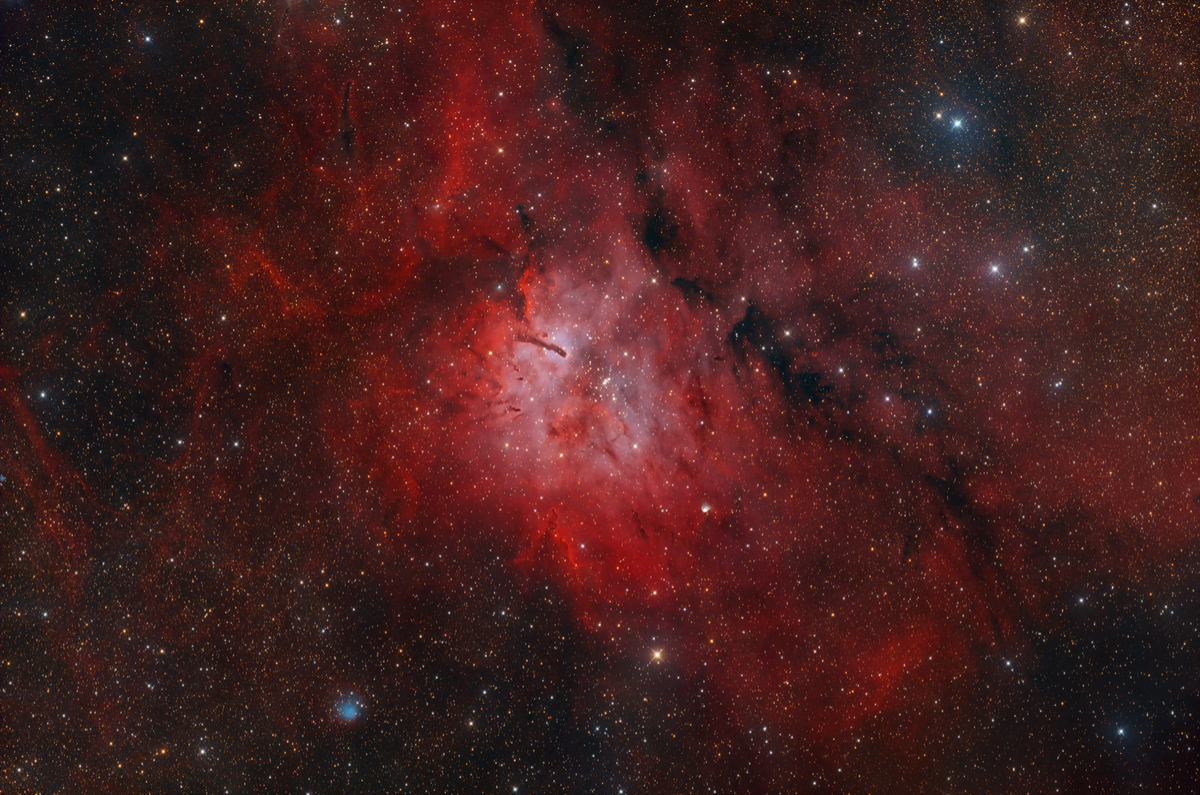
[back] NGC 6823 & friends in Vulpecula
100%
image RGB-version / 100% Bild RGB-Version (9512 x 6296 pixel, 0.743"/pixel)
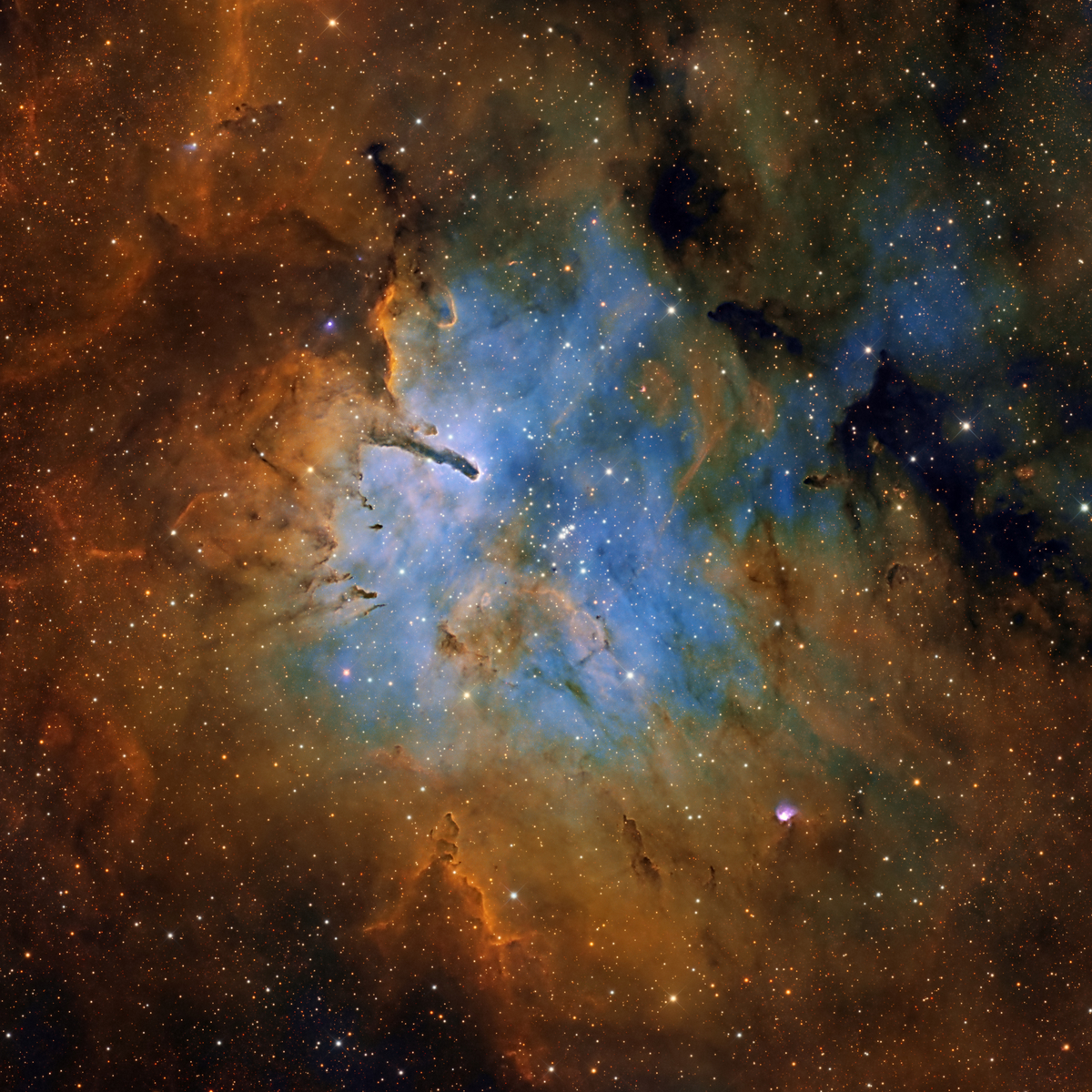
Hubble-Palette-Version of the image center (3920 x 3920 pixel)
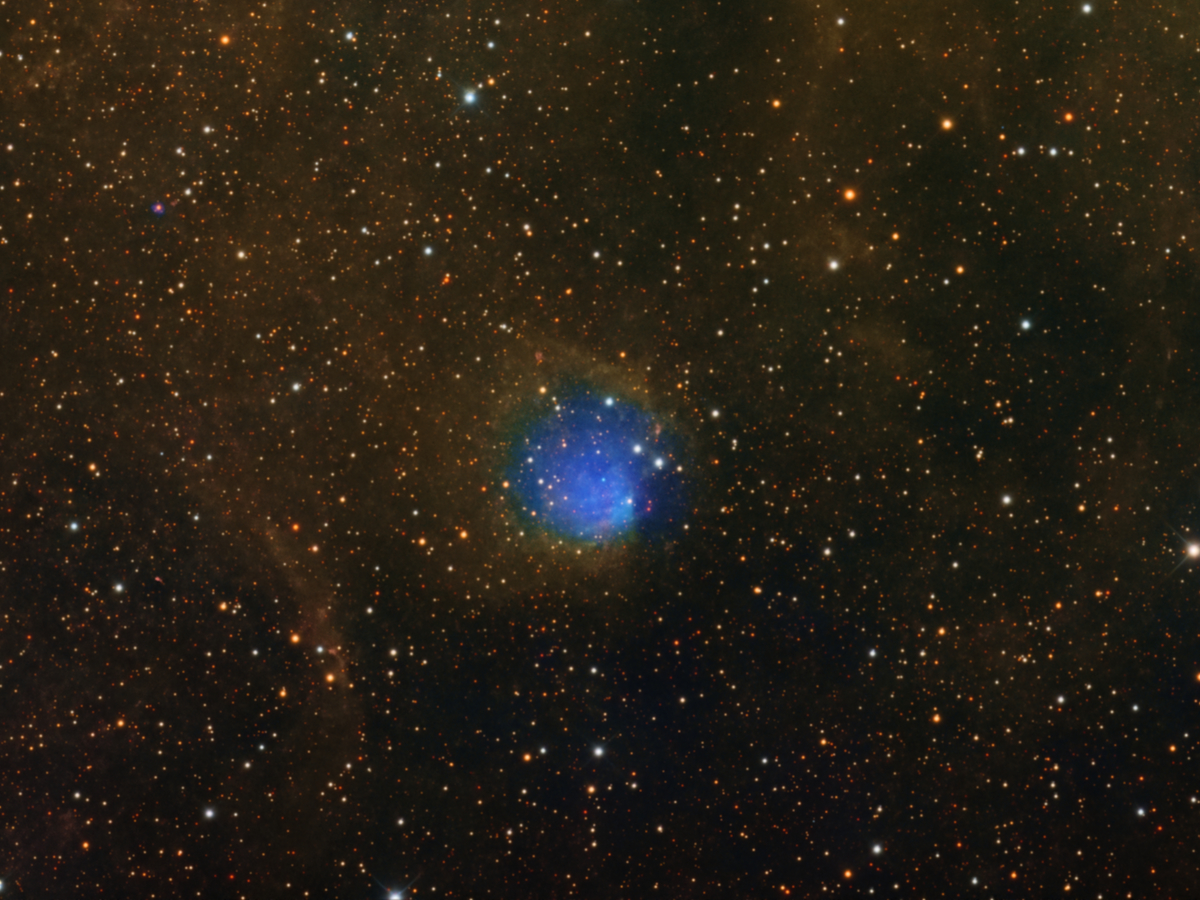
Cropped Kn9, Hubble-Palette (1942 x1456 pixel)
Annotated 100%
image / Beschriftetes 100% Bild (9512 x 6296, 0.743"/pixel)
|
(c) 2026 All astro photo images are copyrighted. They may not be used or reproduced without explicit written permission from the authors. |
|
300" |
|
Hubble-Palette-Version of the image center
|
(c) 2026 All astro photo images are copyrighted. They may not be used or reproduced without explicit written permission from the authors. |
|
300" |
|
Cropped Kn9, Hubble-Palette
|
(c) 2026 All astro photo images are copyrighted. They may not be used or reproduced without explicit written permission from the authors. |
|
60" |
|
About this Image / Über dieses Bild
| Camera: | Moravian C3-PRO-61000 Mono CMOS |
| Image Type, Orientation: | RGB-and SHO Color Composite, North is at 12:00 |
| Exposure time: | RGB: 12/12/12 x 300s, SII: 12 x 900s, H-alpha: 12 x 900s, OIII: 12 x 900s (total 12:00h) |
| Exposure date: | September 28th... October 26th, 2025 |
| Location: | Capella Observatory South at Kiripotib Astro Farm, Namibia |
| Filter: | Astronomik Deep-Sky Deep-Sky RGB Filter plus 6nm Ha,SII,OIII filter on Moravian EFW-3L-9-II External Filter Wheel |
| Instrument: | "Rhea", a PlaneWave DeltaRho 350, 1050mm focal length, 350mm aperture, f/3 on 10Micron GM2000 HPS II Combi |
| Photographer: | Rainer Raupach, Josef Pöpsel, Frank Sackenheim, Stefan Binnewies |
| Remarks: |
NGC 6823 is an open star cluster with an associated
emission nebula in the constellation Vulpecula. The nebula, classified as an
HII region, is listed as Sh2-86 and, as a visually bright nebula, also as
LBN 135. Extending into a cavity carved by the star cluster are globules in which star formation is actively taking place. Evidence for this includes numerous Herbig-Haro objects, notably HH 165, HH 365, and HH 803 (see the annotated version of the image). The associated jets are clearly visible (cf. illustrations in [1]). Within the nebular field, the galactic nebula Cederblad 170, also known as NGC 6820, forms another prominent isolated object and is associated with the star cluster Collinder 404. Several planetary nebulae are present in the field, in particular Kronberger 9 (Kn 9). In 1973, Howard Lanning initially cataloged the star “Lan 21” during a survey focused on ultraviolet-excess stars [2]. Subsequent spectroscopic studies [3] revealed that it is a white dwarf and the central star of the previously described planetary nebula Kronberger PN J1944.9+2245 [4] (later designated Kn 9). Also noteworthy are the filamentary, roughly east-west-oriented structures seen in Hα emission, which are especially prominent in the Hubble palette but are also visible in an earlier LHaGB image captured with Ganymed. |
|
|
|
| Bemerkungen: |
NGC6823 ist ein offener
Sternhaufen mit assoziiertem Emissionsnebel im Sternbild Fuchs. Der Nebel
wird als HII-Region auch als Sh2-86 gelistet, allgemein als hell
erscheinender Nebel auch als LBN 135. |
|
|
|
| References: |
[1] McGroarty, F.; et al. (2004). "Parsec–scale Herbig-Haro
outflows from intermediate mass stars". Astronomy & Astrophysics. 415.
https://www.aanda.org/articles/aa/abs/2004/07/aa0202/aa0202.html [2] Lanning, H.L. (1973). "A finding list of faint UV-bright stars in the galactic plane". Pub. Astron. Soc. Pacific. Volume 85. https://iopscience.iop.org/article/10.1086/129406/pdf [3] Lépine, S.; et al. (2011). "Spectroscopic confirmation of UV-bright white dwarfs from the Sandage two-color survey of the galactic plane”. The Astronomical Journal, 141:96. https://iopscience.iop.org/article/10.1088/0004-6256/141/3/96 [4] Kronberger, M.; et al. (2006). "New galactic open cluster candidates from DSS and 2MASS imagery”. Astronomy & Astrophysics. 447. https://www.aanda.org/articles/aa/abs/2006/09/aa4057-05/aa4057-05.html |
Back to the Diffuse Nebulae Overview / Zurück zur Diffuse-Nebel-Übersichtsseite